Showing posts with label check. Show all posts

Tuesday, July 9, 2013

Output, Outcome and Benefit - Managing today to shape the future

One of the most interesting and fascinating themes in Prince2 project management approach is, for what I am concerned, the business case one.
I find extremely interesting the constant focus on the project's business case and the continued assessment of the project justification, viability, and sustainability.
Also, I have been so impressed by the distinction between Output, Outcome, and Benefit.

Figure 1.

Output Each specialist product that the project has to deliver, be it tangible or intangible. Outputs are commonly delivered after the project’s closure and sometimes even during the project’s life.
Outcome Results of the changes derived from the use of the project's specialist outputs by the users. Outcomes typically start to be achieved after the handover of the project's specialist products to users.
Benefit Measurable improvement resulting from an Outcome. If the outcome is perceived as a disadvantage, we are dealing with what is called a dis-benefit. Benefits generally start to be achieved after the Outcomes and (should) continue to be achieved for a time span planned in advance. Prince2 states the establishment of a specific plan that describes the methods and times to verify the achievement of the expected benefits.

In Figure 2 we can see a quantitative representation of the relationship between these three ideas. Obviously, the exact Outcomes/Benefits realization times heavily depend on the project’s characteristics and peculiarity. 

Figure 2.
Let’s make a simple example to better clarify this view.
The Buymybooks Limited is a small company that sells books via the internet. Orders are collected by means of their internet site but after the initial collecting phase, orders are printed and processed manually. Also, Buymybooks Limited does not have a software to manage its books warehouse.
Their sell and delivery processes are highly inefficient, resulting in delivery errors, high costs, high customers turnover, and progressive reduction in the market share.
To face this situation, the board of director has decided to introduce a management software system to manage the sale and delivery processes.

Output of the project will be an integrated software management system (orders and warehouse management). 
Outcome of the project will be an improvement of Buymybooks Limited sell and delivery processes efficiency.
Benefits of the project will be delivery errors reduction, smaller costs, higher profits and greater customers' fidelity.

So we can agree that there is need to pay a great deal of attention not only to the execution phase of a project but also to the design, support and closure phases. Furthermore, it is of utmost importance check the actual realization of benefits after the project closure. This action should be performed by program or corporate management as prescribed in the project’s documentation. 
As a consequence, I would advise to

1) Have a series of compatible and well-crafted benefits
This seems obvious, but it can be sometimes tricky. I have covered the topic in one old post. It has been conceived for project objectives, but it is well suited for project benefits too.

2) Do not just focus on the outputs delivery
Sometimes, is easy to focus just on output delivery and lose contact with project’s outcomes and benefits. It could happen if outputs are the only substantial point of contacts between the project and the team members (that sometimes ignore the big picture), or between the project and the external stakeholders. 
Also, it is not uncommon to rely just on outputs delivery to measure project’s completion or success.

3) Choose the best possible approach to maximize benefits
Since a significant part of the project’s value will be realized after project’s closure, take care, during project planning, in choosing the best possible project approach to maximize the expected benefits and not just the outputs production. 
In the same way, while drafting the business case, do not take into account just the specialist products realization and delivery costs. Keep an eye also on handover, maintenance and operational costs. 
Manage and execute the project thinking also to the desired outcomes and benefits, trying to increase the probability of success and to maximize their impact on business as usual. 

4) Close a project if it has been proved to be no more justified, viable and sustainable
A project is a mean to reach an objective and not an objective in itself. Stop investing in a project if it is not longer worth it, is not a failure. Honor to the project manager who conscientiously proposes an early closure of its project, out of respect for the corporate vision.
Keep on throwing money out of the window. That surely is a failure.

To keep track of some of this aspects, I suggest the use of two very simple tools.

benefits/benefits matrix (Useful for points 1 and 4)
The first one is a matrix on which all project benefits are listed in columns and rows, sorted by descending importance, from left to right and from top to bottom. Each benefit's importance is recorded near the benefit's code. You can find an example of the benefits/benefits matrix in Figure 3.
At the intersection of each row and column of the matrix, there is a symbol that explains the benefit's relationships. 

Figure 3.

The “+” sign represents a high degree of correlation between two benefits' viability. This bond leads to risky situations because there is a high probability to realize both the benefits (opportunity) or to miss them both (threat). 
The “-” sign accounts for a low consistency between two benefits. This bond leads to risky situations because the realization of one of the two benefit could jeopardize the achievability of the other one.
In the example depicted in Figure 3, the achievability of benefits B2 and B3 is correlated. Benefits B1 and B4 are not consistent, but the real problem is that benefits B2 and B4 are not consistent too and, as a consequence, also benefit B3 is jeopardized. So benefit B4 jeopardizes benefits B2 and B3, that are the most significant benefits of our project.
Especially if one or both the benefits are assessed as paramount, strong “+” or “-” relationships have to be dealt with the greatest attention by the project manager. 
if too much “+” and/or “-” relationships appear in the benefits/benefits matrix, it could be wiser TO conduct an additional analysis of the project's expected benefits and to reassess the project’s riskiness. 
If two benefits do not have specific relationships, the intersection between their columns and lines is left empty. Obviously, the matrix is symmetric by construction and the slashes on the main diagonal are inserted just for the sake of clarity.
Other symbols could be added to account for different relationships, even if I advise to keep things as simple as possible.
Even in this very simple form, this tool could help in identifying dangerous (-) or risky situations (+), and contribute to the definition of the project's objectives.

products/benefits matrix (Useful for points 2 and 3)
The second tool I want to present is a matrix on which all project products (outputs) are listed in rows and all project benefits are listed in columns. Benefits are sorted by descending importance from left to right. Each benefit’s importance is recorded near the benefit's code. You can find an example of the products/benefits matrix in Figure 4.
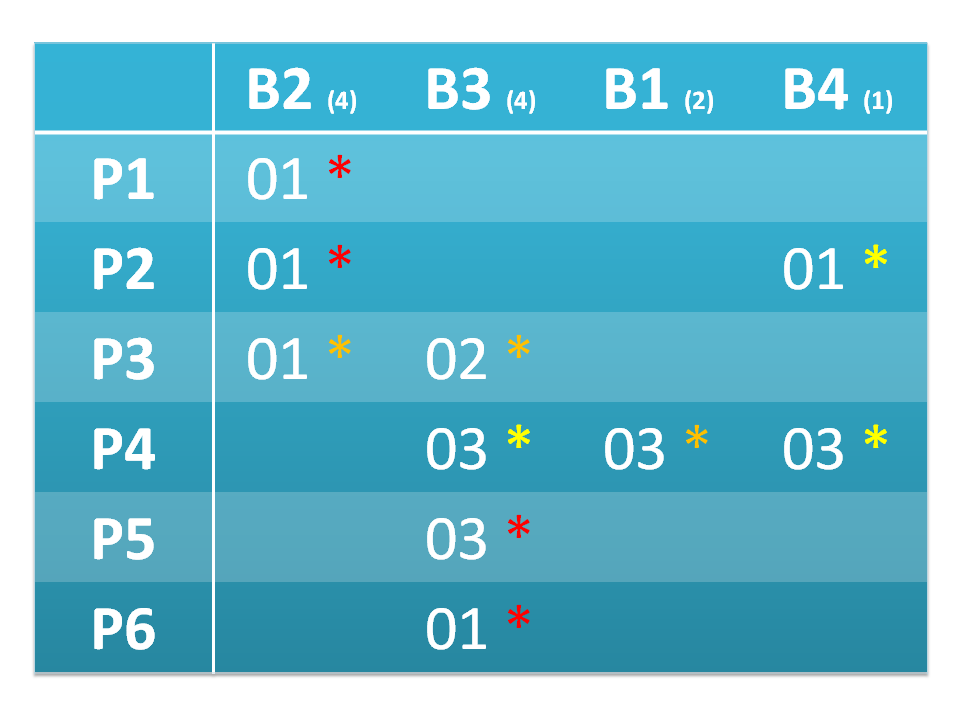
Figure 4.

Each intersection between a row (product) and a column (benefit) contains project's outcome's codes, and represents through which outcome a single product helps to achieve a benefit. The color code states the degree of importance of the product to the expected benefit's realization (e.g., red could mean high, orange average, and yellow low).
We can see, reading the matrix by columns, which product helps to achieve a benefit, and to which degree each product is necessary to this end.
In this way, we can maintain a constant focus not only on project’s outputs but also on project’s benefits, through project’s outcomes.
If we are forced to drop out a product, we can immediately see which benefits are at stake, their importance for the project and how much they are at risk. It is a simple way to depict the effect of a project scope modification on the project benefits.
In the same way, if we decide to sacrifice a benefit, we can immediately evaluate if there should also be a project’s scope modification.

If you feel like to read some suggestion on how to assign importance values to project benefits, please refer to this post. It has been conceived to suggest how to assign qualitative values of impact and probability to project risks, but I think that the content is perfectly adaptable to the current problem.


Licenza Creative Commons
Quest' opera è distribuita con licenza Creative Commons Attribuzione - Non commerciale - Non opere derivate 3.0 Unported.

Friday, May 24, 2013

Are your project objectives S.M.A.R.T. enough?


I love acronyms.
I have always considered acronyms as incredibly shrewd and useful tools, for communicating and for remembering complex concepts in a simple and effective way.
In this post i will focus on one acronym that I came across the first time while studying Prince2 and that, as often happens, I then met again several times in the following days, even if slightly modified.
The acronym is S.M.A.R.T. and, related to project objectives, stands for Specific, Measurable, Achievable, Realistic, and Time Bound.
Honestly, I have to say that there seems to be no universal agreement on the words whose initials make up this acronym, as you can see by following this link. However, the version presented here is the one that I find more congenial and useful to my needs.


Specific
How could you hit a target, if you do not know where the target is? Or worst, how could you hit it, if you do not even know what the target looks like? In the same way you cannot achieve a objective if you do not provide (or if you have not been provided with) a clear description of the objective itself.
It seems obvious, I think that everyone would agree with the previous statement...but please keep in mind that defining specific objectives for a project is not an easy task.
To state or analyze a clear and well crafted business case, considering all present and future developments, benefits and advantages, requires both great project insight and business vision. You could need the aid of a business analyst and, possibly, great support from your corporate management.
If you have been provided with project documentation, in the form of a charter or of a project brief, take your time to examine it carefully and request clarifications wherever necessary.
Never get tired to inquiring your project's documents because, you know, the devil is in the details.
I believe that not to specify clearly project objectives is not a smart (and obviously not a S.M.A.R.T.) shortcut but the highway to failure.


Measurable
All the objectives must be measurable. Period. Always. Period.
If you do not have measurable objectives, it will be impossible to determine if you have been successful or not. It will also be impossible to determine the degree to which the project has fulfilled its expectations.
Also as you might rationally decide to terminate or to continue the project, if you do not have precise targets to measure progress? How could you reassess  the business case? This could result in a massive expenditure of money without proper justification. Also, if you haven’t properly quantified your objectives, it is consequently impossible to determine their risk exposition and, as a consequence, it is impossible to determine the project’s risk exposition. No good. Believe me. 
The problem here is to find proper ways to measure objectives.
Even this one can be a daunting task, depending on the particular industry you are in.
It is easy to measure the number of defective pieces of equipment coming out from a production line, or the lifetime of a new electric bulb. It is more difficult when it comes to customer satisfaction, software quality, reputation improvement, products quality improvement...In these cases an indirect measure could do the job.
As an example you could measure the number of contacts of your customer service  and put it in relation with an improvement or a worsening of your products.
The bottom line is: everything can be measured, the problem is to identify suitable measurement units. It is a complex problem but is a problem that can be and must be solved.


Achievable
Some objectives just do not go well together. They seem to live in orthogonal dimensions.
Sometimes it seems that a complete scope, a fast time to market, a low budget and an high quality standards mix well...as oil and water.
So take care in having an achievable and consistent set of objectives. If it is not the case, try to reconcile reality with management's desires and expectations.
Never start a project that has not achievable objectives, pretending that everything is just fine and thinking ahead how to justify the unavoidable failure or below average performance.


Realistic
Everyone would like to be in charge of the next multi-billion dollars, thousands resources, hundred contracts project, with all the whistles and bells. Reality is, many times, different. 
The project manager’s duty is to reconcile budget, time, scope, quality and all the other constraints into a shared and satisfying vision, be he/she in charge of a mega project or working in small businesses. The duties of a project manager toward the sponsor and the stakeholders do not change with budget’s size. Again, he/she must reconcile reality with management desires and expectations and must resist the temptation to artificially raise the bar in order to magnify its own role.


Time Bound

Every project should have a starting date and an ending date. Every objective should be achieved in the defined timeframe. Benefits could be achieved later on but a time span have to be defined as well.
This is an important commitment for a project manager.
So there is no point in defining objectives that cannot be achieved in the project timeframe or in the expected time for benefits realization, once project products are released in the operation environment.
Otherwise, an attitude of this kind could frustrate team members, create distrust in corporate management and alienate stakeholders. 


Licenza Creative Commons
Quest' opera è distribuita con licenza Creative Commons Attribuzione - Non commerciale - Non opere derivate 3.0 Unported.

Thursday, April 4, 2013

Assumptions and data: never get tired to question them


Let me play a little game with you, just to introduce the subject of this post.
Solve this very easy riddle. 

“Hi, 
I am a very big mammal. 
I am an herbivorous.
I have a grey thick skin.
You can find me in Africa but I have cousins in Asia.
I have been (and I am still) hunted by humans because of something that grows near my mouth.
Who am I?
If you want to meet me follow the link.”


Are you surprised?
Did you expect to meet this other African friend?

Well...you are not totally wrong...or more precisely...you are right...too.
From the data at your disposal both the answers were right. Both these animals are big herbivorous mammals with a grey thick skin. Both of them are present in Asia and have been hunted almost to extinction because of something that grows on their muzzle...and yes...nose and mouth are quite near.
Almost everyone indicates the elephant as a solution for this riddle, probably because elephants are more ubiquitous than rhinos on television, cartoons, books, tales...

What your brain does
The fact is that you have been provided with true but incomplete data and your brain automatically tried to fill the gaps in the best way it could. It tried to interpolate data where informations were lacking.
This capability is something wonderful and amazing at the same time. Your brain, starting from some provided data and past stored knowledge, suggests you answers when you have to take decisions. This same capability is what comes at your help when you have to make an educated guess about some event in the future.
I value this as one of the most important characteristics of human beings.

Take it easy
Please, do not have fear, in this specific case is not your brain that have deceived you...but the other way round...you probably have not provided him with enough time to give a well crafted answer to the riddle I proposed you.
Probably if you had waited a little, if you had just taken your time before trying to give the answer it would have come to your mind that the riddle would have been satisfied by at least two answers. The problem was that everything seemed so perfect, the data seemed so accurate, so precise that you jumped directly to your conclusion. 
This happens in day to day life and in project management too, whenever we have to deal with data and/or assumptions to take decisions.
Sometimes we trust too much the data we have been provided with or the assumptions we have accepted as true, especially when data seem so well crafted and our first answers seem to fit so magically...in this cases sometime we are driven to rush headlong to conclusions.

What we have to deal with
In Figure1 we can see a pictographic representation of a two dimensional data  space, where data and assumptions are placed using their degree of completeness and reliability. Above the yellow line we have data and assumptions more reliable than complete. This is the same situation we have faced with the riddle.
Below the yellow line we can find data and assumptions more complete than reliable.
Both situations are critical.

Figure1.

In the first situation efforts have to be made to collect more data and to refrain from giving the answer too quickly. Take your time. If it is too good to be true...probably it is not true. So try to collect fresh informations and evaluate alternatives to your decision.
In the second one efforts have to be made to verify and validate data and assumptions, discarding corrupted ones. The problem is...how do we know that our data are not reliable or our assumptions are fault? 
Well...the only answer I can offer is to never get tired to analyze, check, question and validate.
Always perform data and assumptions sanity checks, base your analysis on literature, consult with the team, consult with the stakeholders, consult with other project managers and with your project management office... Check lessons learned related to other similar projects if you can access them.

...So
Maintain these behaviors for all the project life. Never get tired to evaluate alternatives and to question and check your data and/or assumptions...or you run the risk to mistake an elephant with a rhino...or even worse...an assumption with a million dollars gamble. 
Thank you for reading.
Bye.


Licenza Creative Commons
Quest' opera è distribuita con licenza Creative Commons Attribuzione - Non commerciale - Non opere derivate 3.0 Unported.